
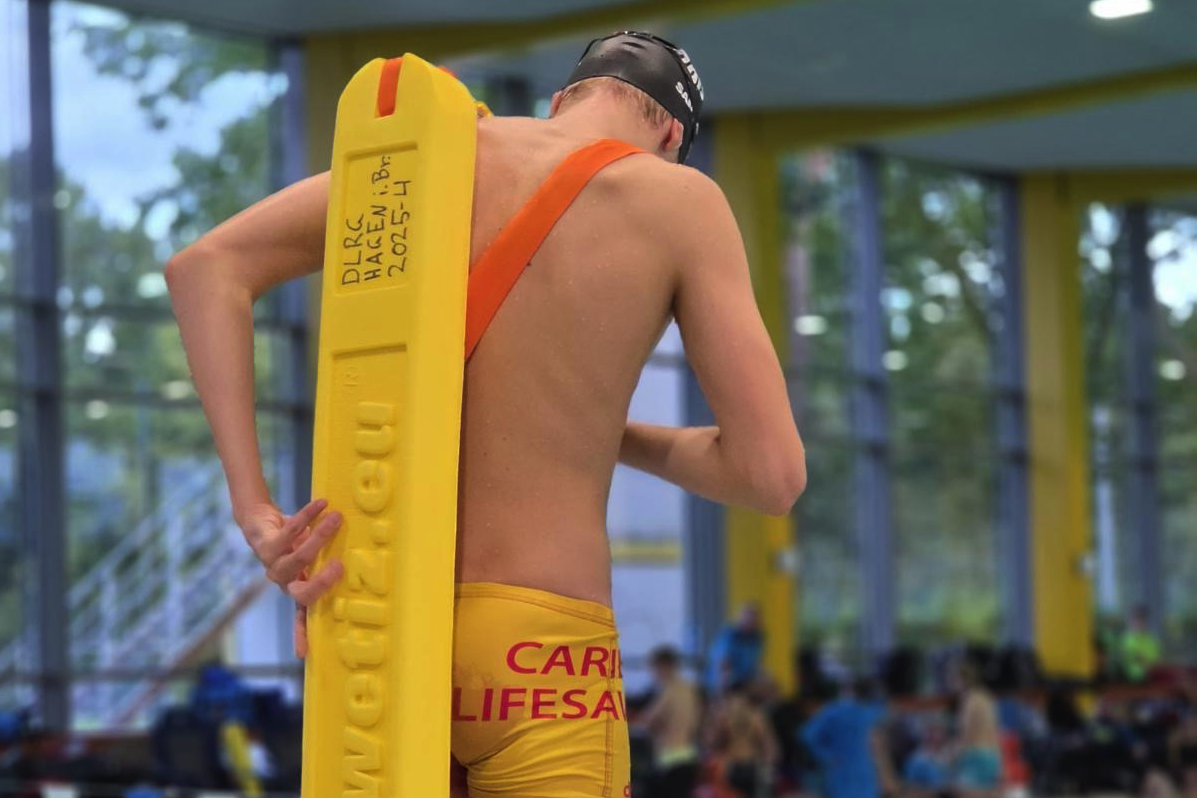
For Finnish lifesaver Samu-Patrik Sula, selection for the Lifesaving World Championships 2026 is the culmination of a journey that began on the Gold Coast in Australia and has seen him combine competitive swimming with his growing passion for lifesaving, now representing Caribia Lifesavers in Finland.
Having learned to swim at just two-and-a-half years old while living on the Gold Coast, Sula was fascinated by the lifeguards working on the 42-kilometre sandy beach near his home. Years later, that early interest would lead him to lifesaving after initially being introduced to competitive swimming.
We caught up with Samu-Patrik to find out more about his lifesaving journey, preparation and ambitions ahead of LWC2026.
What does being selected for the Lifesaving World Championships 2026 mean to you personally?
Finland is a small country, and lifesaving is not a very major sport here. Getting to represent Finland at the World Championships means a lot to me. It is amazing to have the chance to compete against the best junior lifesavers in the world.
Can you share a bit about your background in lifesaving and how you first got involved in the sport?
I learned to swim at the age of two and a half when we lived on the Gold Coast in Australia. In front of our house, there was a 42-kilometre-long sandy beach where lifeguards worked. Even back then, I was fascinated by their rescue boards and what they were doing out in the surf.
By the time I was seven, I was in a competitive swimming school and was asked to join the competitive swimming coaching group because I was a good swimmer. However, I didn’t want to go to competitive swimming practices because I was always freezing at the indoor pool.
Since I live by the sea, my mother felt I needed to have some kind of water hobby to keep my swimming skills sharp. That is how I ended up at lifesaving practices, which were held in a warm spa pool.
I really loved many different types of training at Caribia Lifesavers, including distance and deep diving as well as diving from the boards. At first, I didn’t like the manikin carry at all, but once I found the right freestyle carrying technique and gained more strength, I started to love the rescue events.
Who has had the biggest influence on your lifesaving career, and in what way?
Definitely my coach, Sauli Suominen, from Caribia Lifesavers. When I wanted to try competitive swimming at age 13 and got passionate about it, I no longer had time for lifesaving practice every week. However, Sauli still let me attend lifesaving training every now and then because he believed in me and wanted to give me a chance.
Through competitive swimming, I grew interested in competing, and when Sauli signed me up for the Finnish Lifesaving Championships and I did well, I got incredibly excited about the sport.
Over the last three years of competitive swimming training under Samuli Aalto at Raision Urheilijat, I have developed a strong freestyle technique, endurance and speed. Competitive swimming has helped me believe in myself and has given me confidence and technique for lifesaving swimming as well.
Friends have also played a huge role; lifesaving practices were always fun. I started lifesaving with my friend Waltteri because I was so shy back then as a little kid that I wouldn’t have dared to go to practice alone.
I also have an older sister and an older brother, both of whom have worked as lifeguards for many summers at beaches and outdoor pools. That has certainly influenced my interest in lifesaving too. My older sister was a beach lifeguard, and when I was little, I loved climbing onto her rescue board while she was working.
Can you give us an insight into your preparation or training leading into Worlds? What does a typical week look like for you?
After the Finnish Championships went well in August, I heard about the opportunity to represent Finland at the World Championships. The timeline for preparing for the competition is quite tight, so I have to balance competitive swimming training and lifesaving training.
The main focus of my training is on competitive swimming, and I practice lifesaving two to three times a week. My coaches and parents have put a lot of effort into ensuring I get to train in both 25-metre and 50-metre pools.
A typical week includes six days of training, with swim sessions, lifesaving practice, circuit and gym work, running and water power training. Sunday is usually my rest day, although I add a lifesaving session if I have missed one during the week.
I have also received a lot of great preparation tips from former lifesaving competitors, and the Finnish Swimming Teaching and Lifesaving Federation (SUH) has been very supportive, helping me with things like acquiring equipment.
I gained international competition experience at the Open Championships in Bremerhaven, Germany, on 20 September. The trip was highly valuable because the event was much larger than the competitions in Finland, and I might compete in another lifesaving event in Europe before the World Championships.
Which events will you be competing in, and what are you most looking forward to?
I am competing only in the pool events: 50m Manikin Carry, 100m Manikin Carry with Fins, 100m Manikin Tow with Fins and 200m Obstacle Swim.
I am looking forward to successful performances and, of course, personal bests. All the events feel fun, but the 50m Manikin Carry feels like the most challenging one in which to improve my personal best.
What are your expectations for the competition?
Above all, I am looking forward to new experiences and meeting junior lifesavers from different countries. I have never travelled to South Africa, so that feels very exciting.
I love competing, and my goal is to make it to a final in one of my events.
What’s one thing you’d like people to know about you, either as an athlete or outside the sport?
I love animals, and I have a 10-year-old Samoyed named Sisu at home. Sisu always sleeps next to my bed and waits for me at home after the school day, wagging his tail.
The 2026 Lifesaving World Championships begin in Port Elizabeth, Nelson Mandela Bay on 25 November 2026.